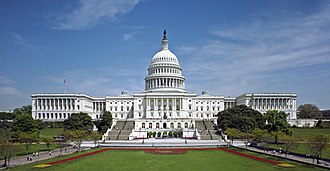
Since the 1980’s Congress has given more and more power to the Executive Branch. Is it time to claw some of that power back?
For as long as I can remember, Congress has relegated itself to junior status in the balance of power.
Generally, Congress either defers to the Executive, or literally gives its power to the Executive.

This is a major problem…one the Supreme Court has recently recognized, though largely for political, not balance of power reasons.
Rulings during the Biden Administration state powers not specifically detailed in legislation, like specific environmental policy, or forgiving Student Loans, are outside the power of the Executive Branch.
This “Major Questions Doctrine” has scaled back the “administrative state”, mostly during Democratic administrations. The GOP has been very keen on dismantling the “administrative state” for most of my life.
Even now, the Court seeks to dismantle the Civil Service, by granting sweeping powers to the Executive. This pushes branch moves closer to the “Unitary Executive” theory that conservative Justices have been pursuing for decades.
Congress should step up
Thankfully, there are three co-equal branches of government.
Congress has, for too long, deferred to the whims of the Executive Branch.
The Judicial Branch seems more than willing to embolden a wildly unhinged Executive. Congress has the power to reign that power in.
Even though the opposition party isn’t in power, the margins are so thin there are lots of opportunity to constrain the wild machinations of our fiddle-less “mad King”.
We’ve seen the result of a weakened Congress under this administration.
This Executive Branch has increasingly operated as if they are above any kind of oversight.
They have ignored calls for Congressional oversight. Blatantly disregarded laws. They have repeatedly gone rogue on judicial rulings, particularly those regarding immigration enforcement.

All the while, Congress, under the leadership of Mike Johnson and John Thune, has operated like nothing is happening.
A not-so-stunning abdication of their responsibility considering their fealty to the mad king.
Constraining the Executive
Congress has the unique power to act as a check on the other Branches. It has a duty to do so when neither will course-correct themselves.
We’ve seen what goes wrong when an executive decides they outside oversight.
In the early days of the second Trump administration, fired Inspectors General en masse.
Trump justified the dismissal by saying he was “treated unfairly”.
That’s not his decision to make.
Under the 1976 law, the OIG is part of the Executive Branch. A 1978 law added that IG’s must be experts in their field.
IG’s are political appointees. The President or a Cabinet level appointee can terminate them. But in most cases, the President must inform Congress of the dismissal 30 days in advance.
The Trump administration tried to skirt these rules, and lost in court. However, the court did not reinstate the IG’s.
One option to strengthen the OIG, is to institute a “for cause” dismissal.
This keeps the OIG in the Executive, but constrains the branch from summarily dismissing an IG without cause, and without informing Congress. It could also have some kind of due process that would protect the IG’s independence.
The Office of Inspector General could become a part of the legislative branch.
Its role would be as an oversight department independent of political influence of the Executive Branch.
Its mandate, to report to Congress regularly on the activities of the executive branch’s execution of laws and policy making.
This change would fulfill a basic constitutional duty of the legislative branch to oversee the executive. It would also give Congress an independent adjudicator.
There are questions about how a legislative branch OIG would work, and the limits of its power to access documents within the branch it would oversee. Doing this would
Judicial Oversight
Another issue is oversight of the Judicial branch.
For some time there have been ethics questions about the Judicial Branch, particularly the Supreme Court.
Several Supreme Court Justices have failed to disclose gifts in the annual filings.
Justice Alito went on a fishing trip with a billionaire who had business before the court. He conveniently missed that gift on his 2008 filing.
ProPublica found Justice Thomas failed to disclose two decades of gifts in multiple filings.
Then there are conflicts of interest. This is an extensive list of times justices failed to recuse themselves, despite apparent conflicts.
Federal District and Appellate courts have specific code of ethics and for conflicts of interest. Ethical rules are administered by the Judicial Conference. The Conference includes many Appellate judges and the Chief Justice.
In 2023, the Court, under public pressure, released new ethical rules for the Supreme Court.
These rules were panned as “designed to fail”.
Since then, many have advocated for Congress to step in.
Just like Congress created the Judicial Conference in 1922, so too can they legislate more rules and ethical enforcement for the whole Judiciary.
An Inspector General for the Federal Courts has been proposed in Congress…though there has been almost no movement.
In any case, the Congress has a duty to intervene when the Court’s response is inadequate.
That time is now.
More details, more specifics
While Congress has had a habit of deferring to the Executive on specific execution of laws, it also has the power to direct the Executive to do specific things within specific constraints.
In the modern era, Congress has been loathe to do this. When one party controlls the Congress and the Executive branch, they are even more reluctant to constrain their own executive.
But they should anyway, because political power is fleeting. For your intentions to stick, you have to legislate them specifically…then make your opponents overturn them.
And while there should be some leeway, in terms of enactment at the Executive Branch, that leeway should be much more narrow than it currently is.

The Executive has taken on the air of “more equal” than Congress and the Judiciary.
This is not how the founding fathers envisioned it.
Under Trump, the Conservative’s theory of the “unitary executive” has become exactly the unaccountable “king” that the founding fathers worried about.
And while the Executive Branch has certainly grown significantly more complex in the 250 years since the Declaration of Independence, Congress shouldn’t defer just because they’re too chickenshit to govern.
I would argue, Congressional inaction, and inability to legislate is part of the reason their approval has been in the ditch for a decade.

This is not the West Wing
Since the airing of Sorkin’s “West Wing” series, there’s been a cadre of “liberals” yearning for the “philosopher leader” that Martin Sheen portrayed.
As Elizabeth Spiers writes in the New York Times, we should be watching “Veep”
Instead of watching “The West Wing,” Democrats should have been taking to heart the lessons of “Veep,” Armando Iannucci’s very different White House series, in which everything dumb and disastrous that can happen does happen.
Politics isn’t some beautiful game played out in the public square.
No, soccer is called the beautiful game. Politics is ugly.
Politics is the thing that keeps us from what Thomas Hobbes called the “State of Nature” where life is “solitary, poor, nasty, brutish, and short”.
Flawed and often ugly, politics is the thing that has protects people from this dire fate. And even though the players are often some of the most venal assholes you’ll ever encounter, there are plenty who actually care.
Politics can protect us from harm. It can also thrust us into it…as we have seen during this Congress and administration.
Which is why a more muscular Congress must be accompanied by a more engaged electorate.
One that votes for what they want rather than against the things they don’t want.
This affirmative shift from “Negative Partisanship” is necessary. It moves Congress to act affirmatively, rather than reflexively.
That’s a post for another time.
For now, we need Congress to step into the void.
It is literally their job. Now, more than ever, we need them to do it.
You must be logged in to post a comment.